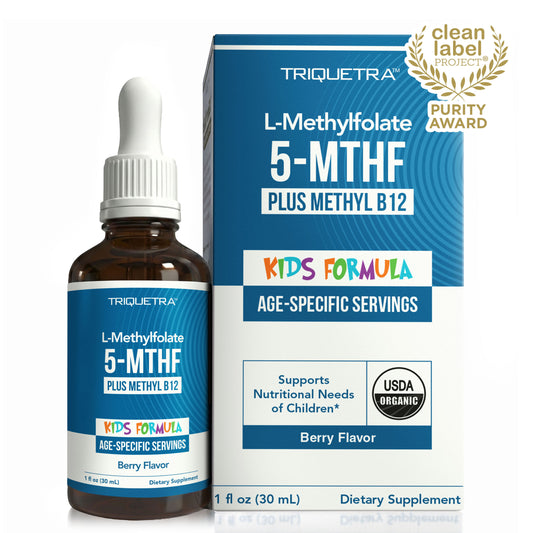
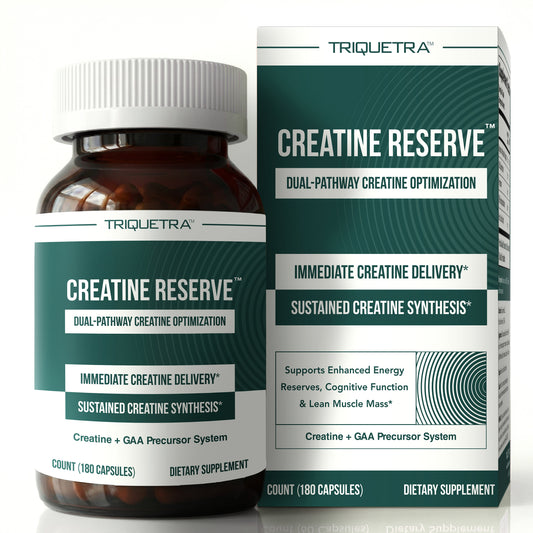
Creatine Reserve™ Dual Pathway Creatine Complex
Woman taking Triquetra Creatine Reserve creatine and GAA supplement capsules for whole-body creatine support, enhanced brain and muscle creatine levels, energy production, cognitive support, and lean muscle performance
Infographic explaining how creatine supplementation alone can reduce natural creatine production while Triquetra Creatine Reserve with GAA supports internal creatine synthesis, muscle energy, brain energy, and whole-body creatine reserves
Infographic showing how GAA supports natural creatine production while creatine provides direct muscle and brain creatine support in Triquetra Creatine Reserve dual-pathway creatine optimization formula
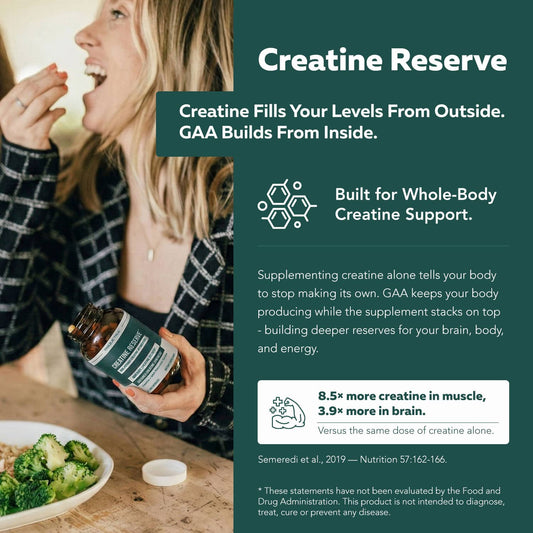
Clinical study infographic showing Triquetra Creatine Reserve increased muscle creatine levels by 8.5x and brain creatine levels by 3.9x compared to creatine monohydrate alone for strength, cognition, and energy support
Ingredient breakdown of Triquetra Creatine Reserve featuring creatine monohydrate, GAA, methylfolate, methyl B12, P-5-P vitamin B6, and taurine for creatine production, muscle energy, cognitive support, and cellular hydration
Man taking Triquetra Creatine Reserve supplement for mental clarity, sustained energy, lean muscle support, workout recovery, cognitive performance, and whole-body creatine optimization with creatine and GAA
Supplement Facts panel for Triquetra Creatine Reserve showing creatine monohydrate, guanidinoacetic acid (GAA), taurine, methylated B vitamins, vegan capsules, third-party tested quality, and 180 capsule one-month supply for muscle and brain creatine support
FAQ infographic for Triquetra Creatine Reserve answering common questions about creatine monohydrate, GAA-supported creatine production, loading phase, bloating, digestive comfort, and daily creatine supplementation benefits for muscle and brain support
Key Ingredients

Six ingredients. Two pathways. One complete system.

Creatine Monohydrate 3,000 mg

The most-studied form of creatine. Fills your reserves from outside the cell, ready to convert into ATP — your body's primary energy currency — at the moment of demand.

Guanidinoacetic Acid (GAA) 750 mg

The natural precursor your body uses to make creatine internally. Enters the production pathway after the suppressed step, keeping your internal creatine factory running while external creatine fills your reserves.

Taurine 300 mg

A conditionally-essential amino acid that supports cellular hydration, mitochondrial function, and the osmotic balance creatine needs to enter cells efficiently.

L-5-Methylfolate (Active B9) 240 mcg DFE

The bioavailable form of folate that bypasses the MTHFR gene variant — present in 30–40% of adults. Drives the methylation reactions that convert GAA into creatine.

Methylcobalamin B12 400 mcg

The active form of vitamin B12. Powers the homocysteine remethylation pathway, clearing the natural byproduct of GAA-to-creatine conversion.

Pyridoxal-5'-Phosphate B6 10 mg

The active form of vitamin B6. Drives the transsulfuration pathway — your body's second route for clearing homocysteine — providing redundant safety architecture.

Health Benefits

What complete pathway support means for how you feel and perform.

Sustained Cellular Energy

Creatine-phosphate is your body's fastest energy currency — recycling ATP at the cellular level for both physical and mental demands. Complete pathway support means deeper reserves, all day.*

Cognitive Performance

Your brain uses 20% of your energy supply. Creatine supports working memory, mental clarity, and cognitive resilience during periods of stress, sleep deprivation, and aging.*

Strength & Recovery

The most-studied performance ingredient in the world. Supports power output, training capacity, and recovery between workouts.*

Lean Mass Support

Creatine works with your body's natural muscle-building processes. Combined with consistent training and protein intake, it supports lean tissue development and retention.*

Healthy Aging

Internal creatine and GAA production decline with age. Complete pathway support — external supply + internal production maintenance — helps preserve cellular energy capacity as you get older.*

Ideal For

Whether you're optimizing performance or preserving capacity — Creatine Reserve is built for active adults who take cellular energy seriously.

The Active Adult

You exercise, you stay engaged, you don't want to slow down. Creatine Reserve supports the cellular energy that powers everything from morning workouts to mental focus through the day.*

The Knowledge Worker

Long workdays, complex problem-solving, late-afternoon energy fades. Creatine supports cognitive endurance for sustained mental output.*

The Adult Over 40

Internal creatine production declines with age — and most of the population isn't getting enough through diet alone. Pathway support helps maintain what your body used to make on its own.

The Longevity-Focused

You're optimizing for healthspan, not just lifespan. Creatine supports mitochondrial function, cellular energy capacity, and the systems that compound over decades.*

The Performance Athlete

You train hard and want every recovery and output advantage. The full dual-pathway system means you're not just topping off — you're building deeper reserves.

Supplement Facts & Suggested Use

Suggested Use

Take 6 capsules daily with a meal. Consistency matters more than timing — creatine works through saturation, building reserves over weeks of daily use.

For optimal saturation: Take consistently for 4–8 weeks to reach steady-state. Many customers notice the first changes in weeks 2–4.

Stack-friendly: Creatine Reserve pairs well with protein, electrolytes, and most performance or longevity stacks. No timing-around required.

One month supply — 180 capsules per bottle, 30 servings.

5-star
8.5× more creatine in muscle. 3.9× more creatine in brain. Head-to-head clinical study. Peer-reviewed.
  • Regular creatine slows the creatine your body makes; Creatine Reserve works with the creatine you make — not in place of it.

  • More creatine isn't the answer. A second pathway is.

  • Built for the body that's quietly running on empty.

Energy
Focus
Muscle
Muscle
Brain
Brain
clinicians_choice
1500+ clinicians share this on FrontrowMD without compensation

Select Your Plan

  • 30-day guarantee

  • 3rd-Party Tested

  • FSA/HSA Eligible

  • FREE shipping on every subscription order

Key Ingredients

Six ingredients. Two pathways. One complete system.

Creatine Monohydrate 3,000 mg

The most-studied form of creatine. Fills your reserves from outside the cell, ready to convert into ATP — your body's primary energy currency — at the moment of demand.

Guanidinoacetic Acid (GAA) 750 mg

The natural precursor your body uses to make creatine internally. Enters the production pathway after the suppressed step, keeping your internal creatine factory running while external creatine fills your reserves.

Taurine 300 mg

A conditionally-essential amino acid that supports cellular hydration, mitochondrial function, and the osmotic balance creatine needs to enter cells efficiently.

L-5-Methylfolate (Active B9) 240 mcg DFE

The bioavailable form of folate that bypasses the MTHFR gene variant — present in 30–40% of adults. Drives the methylation reactions that convert GAA into creatine.

Methylcobalamin B12 400 mcg

The active form of vitamin B12. Powers the homocysteine remethylation pathway, clearing the natural byproduct of GAA-to-creatine conversion.

Pyridoxal-5'-Phosphate B6 10 mg

The active form of vitamin B6. Drives the transsulfuration pathway — your body's second route for clearing homocysteine — providing redundant safety architecture.

Health Benefits

What complete pathway support means for how you feel and perform.

Sustained Cellular Energy

Creatine-phosphate is your body's fastest energy currency — recycling ATP at the cellular level for both physical and mental demands. Complete pathway support means deeper reserves, all day.*

Cognitive Performance

Your brain uses 20% of your energy supply. Creatine supports working memory, mental clarity, and cognitive resilience during periods of stress, sleep deprivation, and aging.*

Strength & Recovery

The most-studied performance ingredient in the world. Supports power output, training capacity, and recovery between workouts.*

Lean Mass Support

Creatine works with your body's natural muscle-building processes. Combined with consistent training and protein intake, it supports lean tissue development and retention.*

Healthy Aging

Internal creatine and GAA production decline with age. Complete pathway support — external supply + internal production maintenance — helps preserve cellular energy capacity as you get older.*

Ideal For

Whether you're optimizing performance or preserving capacity — Creatine Reserve is built for active adults who take cellular energy seriously.

The Active Adult

You exercise, you stay engaged, you don't want to slow down. Creatine Reserve supports the cellular energy that powers everything from morning workouts to mental focus through the day.*

The Knowledge Worker

Long workdays, complex problem-solving, late-afternoon energy fades. Creatine supports cognitive endurance for sustained mental output.*

The Adult Over 40

Internal creatine production declines with age — and most of the population isn't getting enough through diet alone. Pathway support helps maintain what your body used to make on its own.

The Longevity-Focused

You're optimizing for healthspan, not just lifespan. Creatine supports mitochondrial function, cellular energy capacity, and the systems that compound over decades.*

The Performance Athlete

You train hard and want every recovery and output advantage. The full dual-pathway system means you're not just topping off — you're building deeper reserves.

Supplement Facts & Suggested Use

Suggested Use

Take 6 capsules daily with a meal. Consistency matters more than timing — creatine works through saturation, building reserves over weeks of daily use.

For optimal saturation: Take consistently for 4–8 weeks to reach steady-state. Many customers notice the first changes in weeks 2–4.

Stack-friendly: Creatine Reserve pairs well with protein, electrolytes, and most performance or longevity stacks. No timing-around required.

One month supply — 180 capsules per bottle, 30 servings.

2M+ Customers Served
GMP Manufactured
3rd-Party Tested
Clinically Dosed Formula
No Proprietary Blends
Formulated With Science Advisors
HSA/FSA Eligible

The Built-in Decline

Your body made plenty of creatine at 25. By 45, it doesn’t.

The pathway that produces creatine inside your body runs in your kidneys and liver. Like most things, it slows with age. Less internal creatine, less cellular energy on demand. A reserve that used to fill itself now needs help staying full.
The question isn’t whether to take creatine. It’s whether what you’re taking is enough to close the gap.
Biological Trajectory · Age 30–55

After 30, your body's internal creatine production slows. By 45, the gap has been widening for over a decade.

INTERNAL CREATINE PRODUCTION AGE 30 AGE 45 AGE 55 where you started where it's heading

Creatine isn't a muscle supplement.
It's your body's energy currency.

Every cell in your body runs on ATP. Creatine is what your body uses to regenerate it — in your muscles when you lift, in your brain when you think, in every tissue that needs energy on demand.

For thirty years, creatine was sold to gym-goers. The science has always said something bigger.

When your creatine reserves are saturated, your cells have energy. When they're depleted, every system that runs on it quietly underperforms.

Creatine The Currency
ATP The Fuel
Energy On Demand

Saturated reserves. Every cell, every system.

The Category Gap

Most creatine fills you from the outside.
And tells your body to stop building from the inside.

creatine_gaa_bc15c9c7-d368-472e-8640-ea586e693d82
Your Body Stops Producing
Your body produces creatine internally every day through a two-step pathway. When you supplement creatine alone, your bloodstream signals that pathway to shut down. The factory turns off.
You're Replacing, Not Building
Without internal production running, supplementing creatine alone doesn't deepen your reserves. You're replacing what your body stopped making — not building beyond it.
Both Pathways, At Once
Creatine Reserve™ adds GAA — the precursor that enters the pathway after the suppressed step. The supplement fills from outside. Your body keeps producing from inside.*
Two sources. One growing reserve.

The Missing Ingredient

GAA is what your body uses to make creatine.
Most creatine products forget it exists.

The molecule your body needs to keep producing creatine on its own.*

Your body's raw material for creatine.
Your kidneys and liver produce GAA every day — then convert it into creatine. Without GAA, no internal creatine.
It enters the pathway after the shutdown.
Supplementing creatine alone tells your body to stop producing. GAA bypasses that signal — your factory keeps running.*
You can't get GAA from food.
Unlike creatine — found in meat and fish — GAA isn't available from diet. Your body makes its own, and supplementing is the only way to add to it.*
creatine_gaa_creatine

One missing molecule. 
The difference between filling reserves and saturating them.

Achieve higher creatine levels in your body.

Measured. Head-to-head. Published.

A 2019 peer-reviewed clinical trial measured creatine + GAA against the same dose of creatine alone — using MRI imaging to see real creatine elevation in muscle and brain tissue. Same dose. Four weeks. Direct tissue imaging, not blood tests.

The combination didn't elevate creatine a little more than creatine alone. It elevated it by multiples — 8.5× more in muscle, 3.9× more in brain.

The brain finding is especially significant: brain creatine is the hardest to elevate, and dual-pathway delivery reaches it.*
cellular_energy
More cellular energy where your body needs it most.
The Timeline

Real energy is built, not borrowed.

Creatine works through saturation. Your reserves fill gradually with consistent daily use — and the deeper changes compound over time.*

Weeks 1–2

Baseline

Reserves begin to fill. You may not feel a dramatic shift yet — consistency matters more than dose during this window.

Weeks 2–4

First Signal

Most customers notice the first changes here — clearer thinking through long workdays, training sets that finish stronger, less of an afternoon crash.

Weeks 4–8

Deeper Changes

Body composition begins shifting. Recovery between busy days improves. Sustained mental clarity becomes the new baseline.

creatine_raja2
Disclaimer: Individual results vary. These statements have not been evaluated by the FDA. This product is not intended to diagnose, treat, cure, or prevent any disease.

The Safety Architecture

Adding GAA without methylation support is incomplete. We didn't take the shortcut.

When your body converts GAA into creatine, it uses methyl groups — and produces homocysteine as a byproduct. Most creatine + GAA products ignore this.

Creatine Reserve™ includes the active forms of three B-vitamins, handling the methylation load through two independent disposal routes. The result: GAA gets fully converted, and the byproduct gets cleared — through both pathways your body uses for that work.

momocysteine

Two routes. Pre-loaded. Every dose.*

How to Take It

Six capsules daily. One simple ritual.

Built around the dose you actually need — taken however fits your day.

Man taking Creatine Reserve capsule with morning routine
Daily Dose

6 capsules with a meal — taken once daily for simplicity, or split for steady intake throughout the day.

Split-Dose Option

Prefer to spread the dose? Take 3 capsules in the morning with breakfast and 3 in the evening with dinner. Equally effective — choose whichever fits your routine.

Saturation Timeline

Creatine works through saturation. Take consistently for 4–8 weeks to reach steady-state. Most customers notice the first changes in weeks 2–4.

Manufactured to clinical standards.

cGMP Certified
3rd-Party Tested
Non-GMO
Gluten-Free
Soy-Free
Dr. Will Aguila, MD

Dr. Will Aguila, MD

Internal Medicine

Dr. Nicole Avena, PhD

Dr. Nicole Avena, PhD

Neuroscience & Nutrition

Dr. Dan Sullivan, ND

Dr. Dan Sullivan, ND

Naturopathic Medicine

Dr. Ariel Moradzadeh, MD

Dr. Ariel Moradzadeh, MD

Urology

THE SCIENCE ADVISORS

Reviewed by clinicians.
Built on the published research.

  • Science Advisory Board oversight. Practicing clinicians and researchers review Triquetra products against the published literature.
  • Pressure-tested, not rubber-stamped. Their job is to flag what's missing, challenge dose decisions, and require evidence for every claim.
  • Nothing in this formula is here by accident. Dual-pathway delivery, methylation safeguards, and clinical doses — every ingredient and dose reviewed against the published research.

Frequently Asked Questions

What makes Creatine Reserve different from regular creatine?

Creatine Reserve™ uses a dual-pathway approach to support creatine levels.

Most supplements rely on creatine monohydrate alone. Creatine Reserve combines 3,000 mg of creatine monohydrate with 750 mg of guanidinoacetic acid (GAA)—the compound your body naturally uses to produce creatine.
This supports creatine from two directions: direct intake and your body’s own production pathway, which research suggests can increase total creatine availability more than creatine alone.*
Will it bloat me?
No. The 20–25 g loading phase is the source of creatine’s bloat reputation. Reserve skips loading entirely. 3,000 mg creatine + 750 mg GAA daily reaches full saturation in 3–4 weeks. GAA is immediately bioavailable and bypasses the gastrointestinal route that gives monohydrate loading its puffy reputation. Taurine supports cellular hydration without gut bloat.*
Do I have to load?
No. Daily consistency is what matters, not loading. Reserve is dosed at 3,000 mg — the clinical dose studied in published research — so you reach saturation without the 20–25 g loading phase that causes most of the bloat and GI complaints associated with creatine.*
Does it actually reach my brain, or just my muscles?
Yes — through SLC6A8, the brain’s preferred creatine transporter. Standard monohydrate is built for muscle and can’t fully use this pathway. GAA is the molecule that crosses the blood-brain barrier and reaches brain tissue, where it supports the phosphocreatine your prefrontal cortex runs on.*

What is GAA and why include it?

Guanidinoacetic acid (GAA) is the direct precursor to creatine in the body.

By providing GAA alongside creatine monohydrate, Creatine Reserve supports both the creation and replenishment of creatine. The formula also includes active B vitamins to support the metabolic conversion of GAA into creatine.*

How long does it take to notice results?

Creatine works by gradually increasing creatine stores in muscle and other tissues.

With consistent daily use, many people notice benefits in performance, recovery, or mental energy within 2–4 weeks. No loading phase is required—daily consistency is what matters.*

Does creatine support brain function?

Yes—creatine plays a key role in cellular energy production, including in the brain.

Supporting healthy creatine levels may help support focus, mental endurance, and cognitive performance, especially during periods of high demand.*

Is GAA safe?

GAA is a naturally occurring compound involved in creatine production.

At the levels used in Creatine Reserve—and when paired with supportive nutrients like B vitamins—it has been studied in the context of creatine supplementation. The formula is designed to support normal metabolic pathways involved in creatine synthesis.*

Is creatine safe? (Kidneys, hair loss, sleep concerns)

These are the most common questions—and the current evidence is reassuring:

Kidneys:
Creatine can raise creatinine on standard blood tests, but creatinine is a downstream marker—not a direct measure of kidney function. Large reviews of clinical trials in healthy adults have not found evidence of harmful kidney effects.
Tip: let your healthcare provider know if you’re taking creatine before blood work so results are interpreted correctly.

Hair loss:
Concerns stem from a single small 2009 study measuring a modest increase in DHT. This finding has not been replicated, and the broader body of evidence does not support 
creatine as a cause of hair loss.

Sleep:
Published data is generally neutral to positive. A recent randomized controlled trial in midlife women reported improved sleep quality in the creatine group. Individual responses can vary.

*These statements have not been evaluated by the Food and Drug Administration. This product is not intended to diagnose, treat, cure, or prevent any disease.